Sep, 2025
"The Israeli settlers demolished our school and our clinic. We abandoned everything, which has since been taken or destroyed, who knows."
Jamal Mlehat, known as Abu Amer, is a 45-year-old Bedouin father of five children, all under the age of 16. For more than four decades, he called the Bedouin community of Mo’arajat near Jericho home.
“I lived there since I was two years old,” he recalls. “I went to school there. I got married there, had all my children there and buried so many loved ones there. We made such a good life for ourselves in that area.”
Like many Bedouins in Palestine, Abu Amer’s story is one of repeated displacement. His family was first pushed out of the Naqab (Negev) during the establishment of Israel in 1948, when entire communities were stripped of their lands, homes, and livelihoods and forced into the West Bank.
They moved to the outskirts of Hebron, only to be expelled again in 1967, when Israel occupied the West Bank and dismantled the last vestiges of the Bedouins’ nomadic lifestyle and freedom of movement.

Caught in this cycle of loss, Abu Amer’s family struggled to rebuild each time, eventually settling in a place called Jisa. Today, it is the site of the Israeli settlement Ma’ale Mikhmas.
Before the Israeli government built this settlement, they forced all the Bedouins out, he recalls. “In 1980, the military kicked everyone out of that area and that is when my family moved to Mo’arajat in Jericho.”
For years, life in Mo’arajat offered stability. Abu Amer built a modest home: tin sheets, a small bathroom, a kitchen and a bedroom. “It was a humble home, but it was ours that I built with my own hands. We have so many great memories there,” he says.
But three years ago, that sense of peace began to unravel. Israeli settler herders set up outposts nearby and started harassing the community. After the Gaza war erupted in October 2023, the harassment turned violent.
"It just kept getting worse and worse. They even set up their tents near our homes and would harass us in the middle of the night as we slept. They allowed us only a few meters of land for our cattle to graze. If one of our cattle crossed the line, they would take it and call it fair game.”
- Abu Amer
For Abu Amer, these attacks were devastating. “They stole 35 of my cattle. These cattle are my life and my livelihood,” he says. “If we reported it to the Israeli police, they did nothing and only protected the settlers.”
The violence escalated.
“They would throw tear gas in our homes as we slept. They even once sprayed gas in my mouth,” he recalls. “We just couldn’t take it anymore.”
Yet he retains a sense of defiance. Abu Amer speaks with quiet pride about what his people represent. “If you know anything about Bedouin communities,” he says, “you know that we are all very tight-knit, and our presence on the land protects it from annexation. That is always a threat to Israel. They know that if we stay, we keep the land Palestinian.”

The final straw was when nearly seventy armed settlers appeared one evening, and threatened the entire community of 70 families with violence if they did not leave. Understandably, with no one to turn to, the Bedouin community collectively decided to leave, carrying only their most important belongings and leaving everything else behind.
“The Israeli settlers demolished our school and our clinic. We abandoned everything — now it has all been taken or destroyed, who knows which.”
The displacement has left deep scars. “My children are all traumatized and even my cattle are not the same,” Abu Amer says. Their new location is isolated and cut off from the main road to Jericho and are only about 10 families.
“Before, people would stop to buy cheese, milk, and cattle from us because our land was along a main entry route to Jericho. Now we are in a location completely cut off from the world, with no facilities, and the family members we lived alongside for years have been displaced to different areas.”
His children’s education also weighs heavily on his heart. Since they moved to their new location, his children have been out of school.
“In our original community, we had a school, a health center and a life. We were around 70 families living together for years. Now, my children are no longer in school.
“I don’t want a castle. I want my children to go to school and be educated. Everyone has the right to education. I always tell my children: a body without education is not powerful, but a body with education is.”
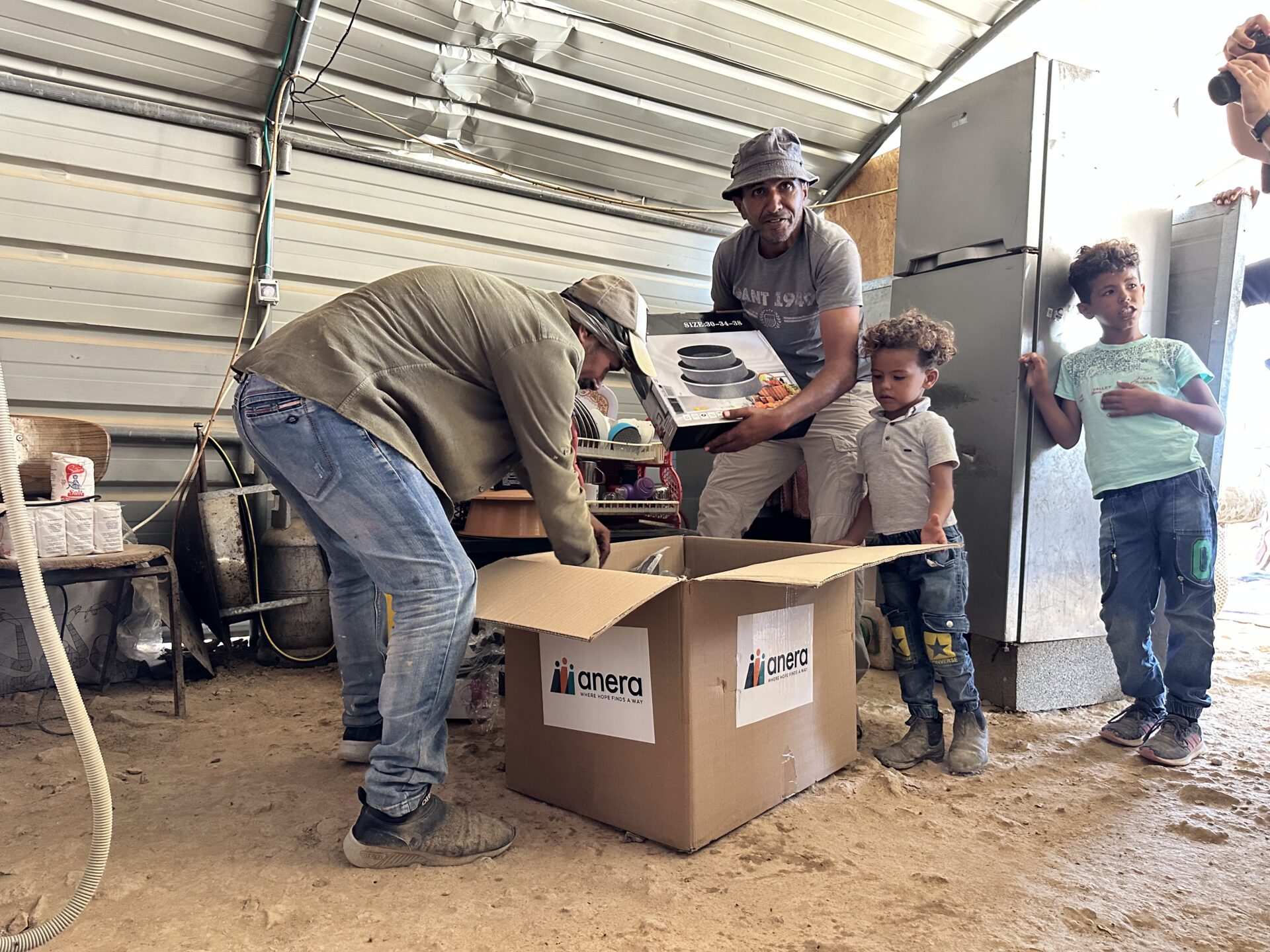
When Anera delivered a new kitchen kit, it brought a small measure of relief. “I was so happy for the kitchen kit because we are missing so many essentials in our kitchen and we are forgotten,” Abu Amer says.
While the kit can hardly undo the trauma or replace the home and community they lost, for Abu Amer and his family it is a reminder that they are not forgotten and that even in displacement, their dignity matters.