May, 2026
For Gazans who have health conditions that threaten their lives, simply pushing through is not sufficient. Their demands are urgent, challenging to address and multifaceted.
What the Gaza Patient Support Program Does
Anera’s support program for patients from Gaza accompanies evacuated patients and their families through every stage of care in Jordan, from arrival and medical treatment to recovery and ongoing support.
As Jordan continues to serve as a critical humanitarian corridor for medical evacuations, some 661 people have arrived to date, including 196 patients, most of them children.
The program focuses on patients living with chronic illnesses and devastating war-related injuries, while also supporting the caregivers and family members who shoulder the immense burden of care and displacement alongside them.
Anera’s program delivers a multi-sector response that includes:
- Life-saving medical support (treatment, medications, diagnostics and referrals)
- Psychosocial care for patients and families facing trauma and uncertainty
- Food assistance and winterization support for vulnerable households
- Case management and coordination to ensure continuity of care

This holistic approach acknowledges that treatment alone will not suffice in a scenario where everything else around the patient remains unstable.
As highlighted in a recent report by OCHA, people from Gaza continue to face severe gaps in access to healthcare, basic services and protection, both inside Gaza and in displacement. These pressures directly shape the needs seen in Jordan today.
Displacement Beyond Borders
When a person is evacuated from Gaza, their suffering is not left in Gaza. They arrive in Jordan after having lost everything, followed by the uncertainty forced by displacement.
"When you remove the person from their home, country and environment, they immediately have nothing. Basic things are no longer guaranteed,” reports Rozana Zarour, Anera’s Gaza support project manager.
Families are hosted in hotels across the capital, Amman. Despite the rather hospitable conditions, for immuno-compromised patients, even minor disruptions in hygiene, nutrition or routine, can become life-threatening.


Care Beyond Medicine
This is only one part of the broader picture. Through her role as a project manager on the ground, Rozana serves as a vital link between patients and Anera, helping communicate their needs, concerns and day-to-day realities directly to the organization. “We are dealing with patients who have their lives hanging by a thread. At the very least, we must make sure not to endanger them further.”
When evacuated families arrive, their needs continue. The issue of finding adequate nutrition for sick children is a financial barrier that parents face. They also grapple with hygiene and basic survival needs. Fieldwork insights reveal that even minor aspects such as access to washing clothes and areas for washing themselves have considerable effects on the well-being of patients.
In addition, due to prolonged conflict and instability, mental health issues are prevalent among evacuees. “Sometimes just having a moment when they can laugh and children can play reminds them that they are still human beings,” says Rozana. As a result, Anera provides psychosocial support, recreational activities and safe spaces where families can reconnect, creating a sense of normalcy, however temporary.
.
23 Young Lives in Urgent Need
A group of children from Gaza (1 to 17 years old) evacuated recently to Jordan to receive medical care. Each one of these children carries an urgent story due to the conflict and the deteriorated healthcare system in Gaza.
Their most urgent needs include treatment for war-related injuries and orthopedic conditions, neurological and congenital diagnoses requiring specialized interventions, chronic ear diseases requiring ENT care, gastrointestinal complications, urological and renal conditions and blood disorders. Anera continues to provide close follow-up after evacuation, coordinating treatment, referrals and ongoing support to give these children the best possible chance at recovery.
A Growing Gap
Despite all efforts, needs are greater than resources. The size of the humanitarian catastrophe and weakened health systems mean many people cannot get the treatment they need.

“We had plans to treat dozens of patients from start to finish. Today we are still waiting. And they are still waiting,” says Rozana.

A Call to Care
The priorities remain clear: ensuring patients can access life-saving treatment without obstacles, providing families with stability throughout displacement, and supporting their mental and emotional well-being during an incredibly difficult time.
For patients whose lives are already at risk, timing is critical.
“If we can’t heal them, the very least we can do is ease their hardships,” says Rozana.
Care is not defined only by medical outcomes. It is found in the reassurance of a parent sleeping beside a hospital bed, the dignity of being treated as more than a case number, and the human connection that helps families endure displacement, fear and uncertainty. Right now, that kind of care is desperately needed.
Gaza
Gaza City Governorate
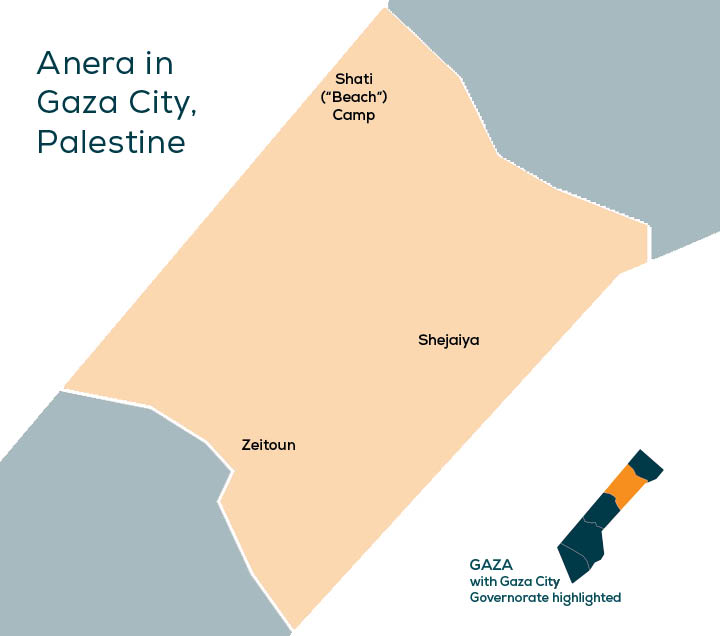
In 1984, Anera’s Gaza City office opened with three staff members. It is still at the same location today, but with 17 staff members. From that location, the team manages water and sanitation, education, healthcare, economic development, and humanitarian relief projects throughout Gaza.