
Humanitarian Access Snapshot (Jan. 19 – Apr. 15) for Gaza and the West Bank
 by Anera
Posted in: Report
Download the full Humanitarian Access Snapshot
Anera and 25 other humanitarian organizations have jointly released a new report on the humanitarian situation in the West Bank and Gaza. On the same day, the heads of 12 major aid groups have published a statement on the crisis: “Let Us Do Our Jobs.”
A brief and fragile ceasefire in Gaza between January and early March 2025 permitted a limited scale-up of humanitarian assistance. This was abruptly and catastrophically reversed on March 2, when the Israeli government reinstated a total siege, halting all humanitarian and commercial entry into Gaza. The siege has now lasted over six weeks—marking the longest such blockade in Gaza’s history—and was compounded by the resumption of intense military bombardments beginning March 18. Since then, more than 1,630 Palestinians have been killed, 4,200 injured, and nearly half a million forcibly displaced.

The situation in the West Bank has also sharply deteriorated, with Israeli forces demolishing homes, forcibly displacing 40,000 Palestinians, and targeting critical infrastructure. Humanitarian actors across Palestine face relentless access restrictions, violence, and bureaucratic obstructions, rendering aid operations nearly impossible and exposing civilians to escalating threats of starvation, dehydration, untreated illness, and death.
A survey of 47 NGOs operating in Gaza and the West Bank revealed widespread disruption:
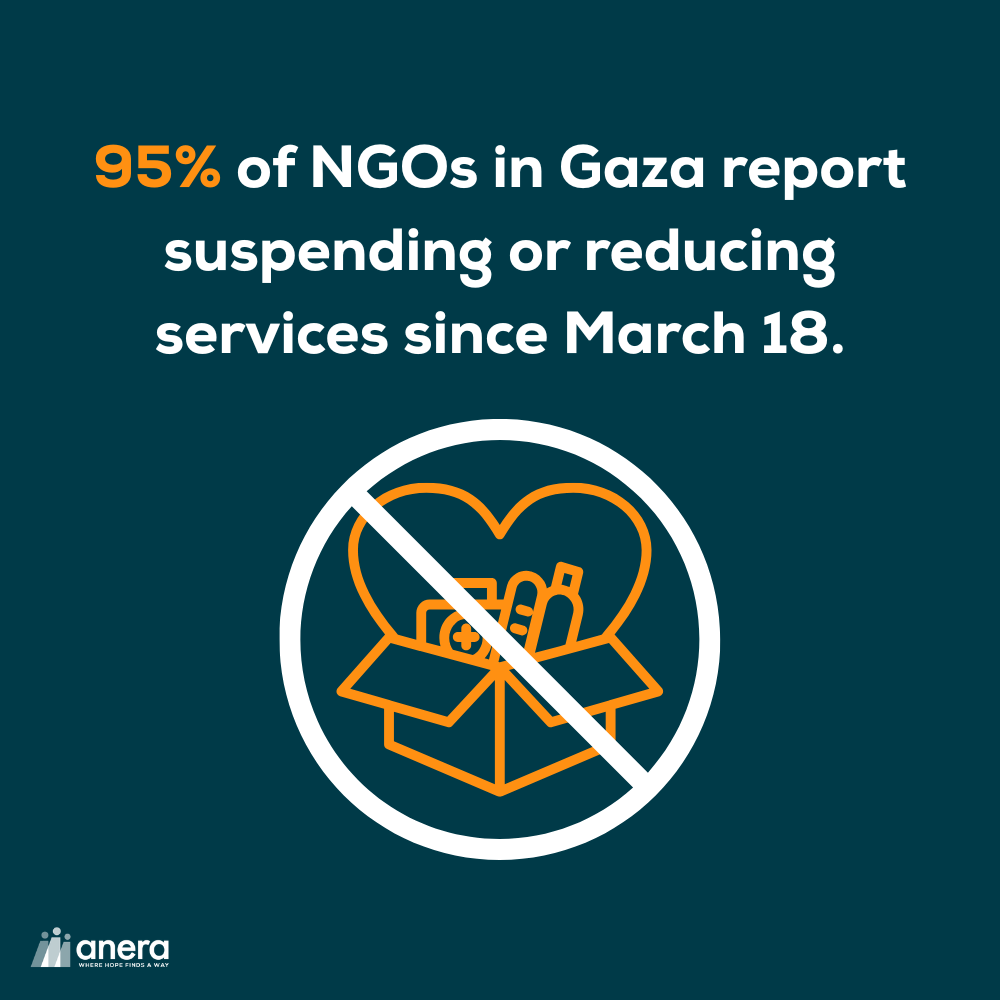
- 95% of NGOs in Gaza report suspending or reducing services since March 18.
- 8,881 pallets of aid remain stranded outside Gaza due to the complete blockade.
- 61 aid workers have been killed or injured since January.
- 95% of NGOs working in the West Bank report increased movement restrictions.
- 15 NGOs report harassment or attacks while delivering aid in the West Bank.
The timeline of documented Israeli attacks includes strikes on UN facilities, hospitals, community kitchens, and NGO compounds—even those previously deconflicted—resulting in mass casualties among aid workers and civilians. The UN has called Gaza a “killing field,” with civilians trapped in an “endless death loop.”
Fundamental humanitarian conditions are being systematically violated:
- Reliable entry of essential supplies is blocked by arbitrary denials and shifting criteria, even during ceasefire periods.
- Safe access for aid workers is undermined by direct attacks, harassment, and the denial of deconfliction mechanisms.
- Infrastructure required for aid delivery, including water, electricity, and telecommunications, is being destroyed or cut off.
- Civilians’ access to aid is impeded by military operations, displacement, and lack of distribution routes.
These actions, compounded by global funding shortfalls, have weaponized humanitarian aid and are producing mass preventable deaths, particularly among children, pregnant women, and the elderly. With over 51,000 Palestinians killed in Gaza since October 2023, this crisis demands urgent international action and accountability.

OUR BLOG
Related
by Anera
Lebanon is experiencing a rapidly escalating outbreak of foot-and-mouth disease among cattle, posing a serious threat to farmers’ livelihoods and the country’s food security. The highly contagious viral disease, which affects cloven-hoofed animals such as cattle, sheep and goats, has…