
From Assessment to Action: Preventing the Collapse of Agriculture in Gaza
 by Anera
Posted in: Report
As the people of Gaza rely on aid organizations for assistance in surviving another day in an area that has been ravaged by war, we must also look towards their long-term needs for a future when fear and destruction aren’t a constant in their lives. On April 7, Anera convened a roundtable with 60 partners and stakeholders at a critical moment when clarity, coordination and commitment are urgently needed. The discussion was grounded in findings from Anera’s recent rapid assessment of Gaza’s agriculture sector, which offers one of the clearest snapshots to date of conditions on the ground.
An Anera staff member in Gaza told participants the frightening truth: “We are no longer trying to recover. We are trying to prevent complete collapse.”
Approximately 1.7 million people in Gaza are displaced and living in overcrowded shelters with limited access to basic services. Markets function day to day without reserves or stability. There is not enough aid to meet even basic needs. People are surviving, but the systems that sustain dignified life, such as food production, water access, healthcare, hygiene, education and livelihoods, are no longer functioning.
Led by Anera’s teams in Palestine, the agriculture needs assessment draws on a combination of data analysis and direct engagement with farmers, suppliers and local institutions operating under extraordinary constraints. It provides a practical, evidence-based snapshot to guide immediate recovery efforts by using secondary data, stakeholder consultations and field engagement in accessible areas to identify both the scale of damage and the sector’s most urgent needs.
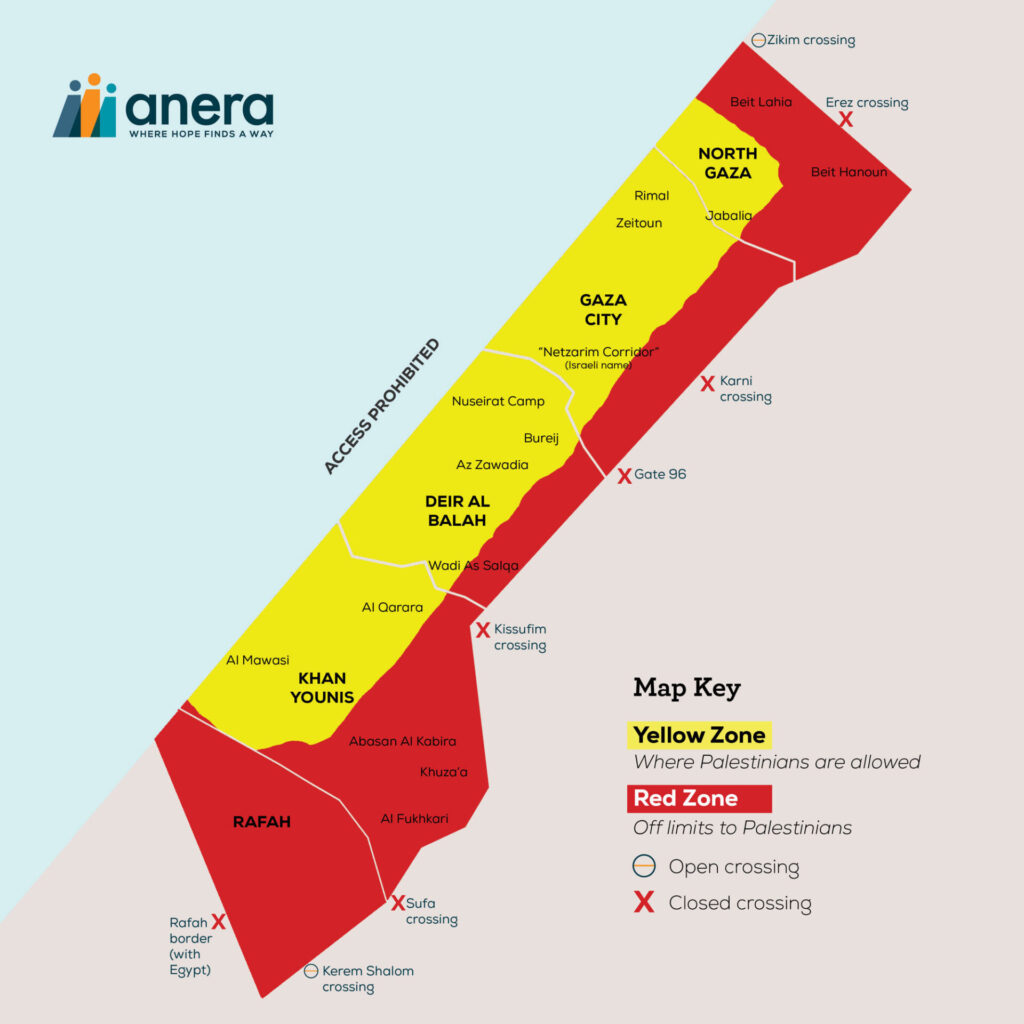
More than two years of war have devastated Gaza’s agricultural sector, particularly near the Israeli border, where roughly 60% of farmland and infrastructure now fall within restricted or inaccessible zones. The damage is both direct and indirect: fields and infrastructure like greenhouses have been destroyed through bombardment and land leveling, while restrictions on the movement of goods have limited access to essential inputs such as seeds, fertilizers, fuel and equipment. Many farmers are also unable to even reach their land. The entire production cycle has been completely upended.
The assessment shows that Gaza’s agriculture sector is under immense strain, but not without some potential. Before the war, agriculture was a key economic driver in Gaza, contributing about 11% of GDP, generating more than half of exports, and supporting tens of thousands of farmers, laborers and fishers. Today, much of that capacity has been lost. Around 63% of cropland is now inaccessible, largely within active military zones, while another 32% is damaged. Only about 4% remains both undamaged and accessible – and even there, high input costs and limited water access constrain production.
Greenhouses show a similar pattern. More than half are destroyed or inaccessible, while many of the rest are damaged but potentially recoverable. Yields have dropped sharply, by up to 50% in open fields and even more in greenhouse systems, while operational costs have surged, in some cases by more than 150%. For many farmers, continuing to cultivate is no longer economically viable.
Yet the assessment also highlights where recovery can begin. In accessible areas, some farmers continue to produce, supported by a small number of functioning nurseries supplying seedlings. Local markets retain limited agricultural inputs and small-scale production persists despite the challenges. These pockets of activity point to a critical opportunity: with targeted support, parts of the system can be brought back into operation.
Not all food security subsectors face the same outlook. Livestock and fisheries are far more constrained, with up to 90% of related infrastructure destroyed or inaccessible and severe shortages of feed, veterinary supplies and fishing access. Recovery in these areas is not feasible in the near term. By contrast, vegetable production offers a more immediate pathway forward: it requires relatively modest investment, has shorter production cycles and can yield results in both food availability and income within months.
Based on these findings, Anera has identified a set of practical, prioritized interventions to support early recovery including:
- Rehabilitating farmland and greenhouses
- Restoring irrigation systems and agricultural wells
- Providing farmers with essential inputs
- Creating short-term employment linked to land restoration and cultivation.
- Training and capacity building as farmers adapt to limited inputs and shifting conditions
These efforts are organized around three core pillars: land rehabilitation, support to farming operations and strengthening water supply and irrigation systems. Together, they aim to bring damaged land back into production, sustain farmers who are still operating, and expand access to water, which is one of the sector’s most critical constraints.
This assessment is a starting point that is grounded in evidence, shaped by farmers’ realities, and focused on what is possible now.
Even under these conditions, one thing is clear: where there is even a narrow window of opportunity, Gaza’s farmers are ready to act. Our challenge, and responsibility, is to ensure they have the support to do so.