
Before the Taps Run Dry
 by Anera
Posted in: Life in the Middle East, Report
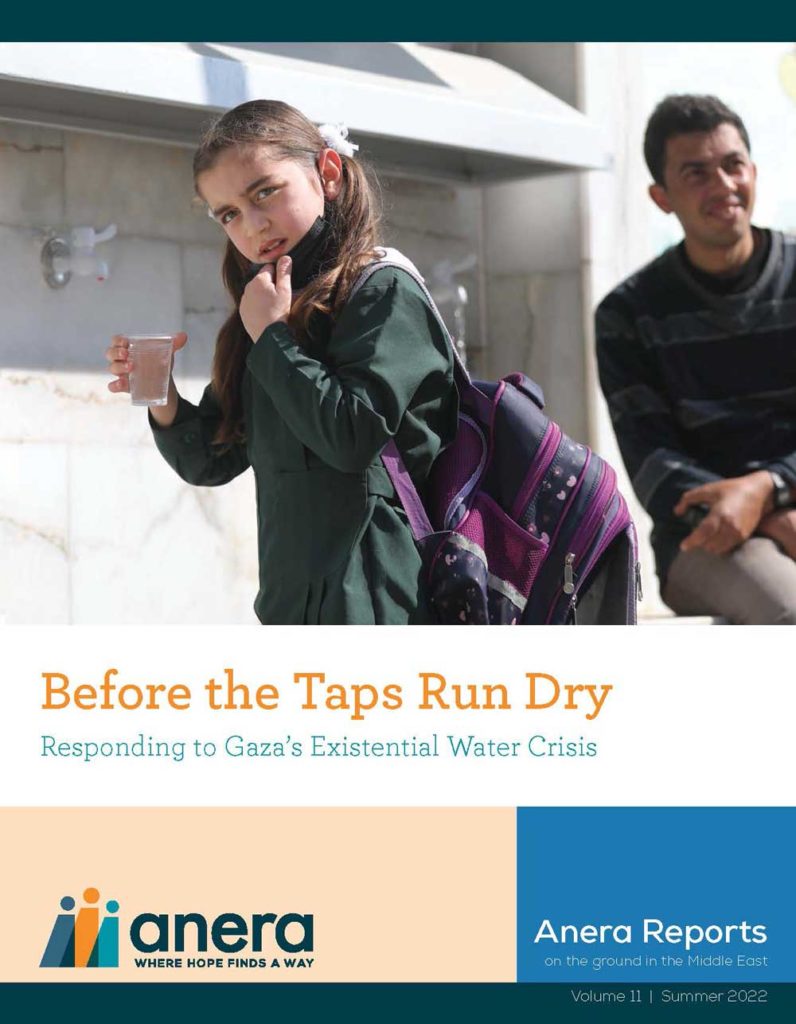
Responding to Gaza’s Existential Water Crisis
The semi-arid Middle East suffers from a chronic scarcity of water. The causes are many: climate change, drought, desertification, urbanization, over-consumption, waste and pollution. Politics also can present special challenges when it comes to accessing and distributing water resources. In Gaza, many of these issues are present in an extreme form.
The Gaza Strip is a 25-mile long stretch of coastal land (141 square miles, 365 square kilometers) that is home to a growing population of more than two million people. It includes eight recognized refugee camps that have some of the highest population densities in the world. Years of hostilities and a major blockade have crippled the economy and reduced much of the region to desperate levels of poverty. These conditions are demonstrated most clearly in the inability of the Gazan people to secure reliable access to some of the most basic necessities of human existence — water, sanitation, and power.
With virtually no potable water, severe limitations on available electricity, and raw sewage flowing from the streets to the sea, Gaza’s inhabitants do what they can to live normal lives. In Gaza City, one of the oldest continuously inhabited cities in the world, families struggle to maintain their daily routines, even as unsustainable conditions worsen. And, throughout Gaza, it is resilience in the face of despair that most aptly describes the people today.
Our new on-the-ground report looks at the deteriorating conditions of water, sanitation and wastewater management in Gaza, and the efforts by the Gazan people, together with some international actors, to forestall the further degradation of living standards in the region.

OUR BLOG
Related
by Anera
Today, August 19, is World Humanitarian Day, created to honor humanitarian workers and reaffirm the principles that allow them to reach people in crisis. This year’s theme, “Strengthening Global Solidarity and Empowering Local Communities,” is especially meaningful for Anera. Our…