
The Current Humanitarian Situation in Gaza
 by Anera
Posted in: Report
This page reflects the latest on the humanitarian situation in Gaza, including updates across key sectors, such as health, water and sanitation, food security, education and shelter. This page will be updated periodically to capture the most up-to-date information on the crisis.
Health
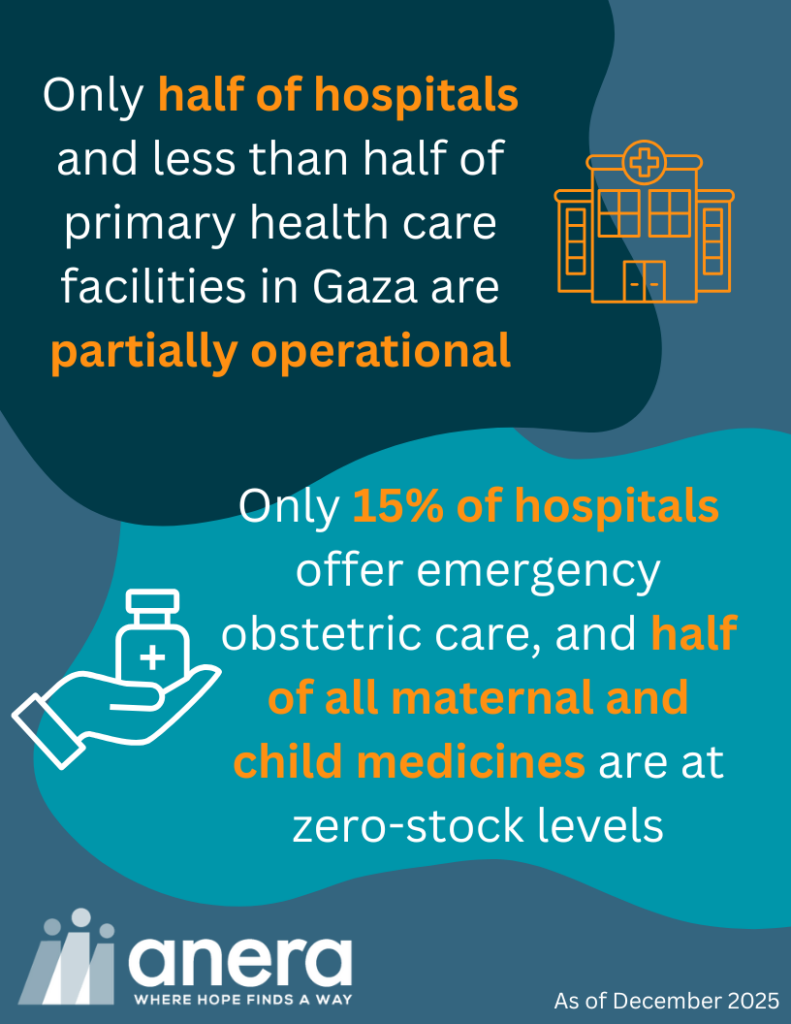
Health infrastructure in Gaza remains shattered and vulnerable. Only half of hospitals and less than half of primary healthcare centers are currently even partially functional. Those that are operating face critical shortages of essential medical equipment, medications and supplies. Although approval rates for importing medical supplies have improved since the ceasefire, the process of actually getting medical supplies into Gaza remains unnecessarily difficult.
Health infrastructure for pregnant women is particularly fragile. According to the UN Population Fund, every week about 15 women in Gaza give birth outside hospitals and without skilled attendants. Access to maternal and child health treatment remains limited, with about half of all maternal and child health medicines at zero-stock levels, family planning services extremely scarce and screening procedures for breast and cervical cancers ceased. Additionally, only 15% of health facilities offer emergency obstetric care, and neonatal units are currently operating at up to 170% of capacity, often requiring newborns to share incubators.
Children’s health also faces a particular threat. According to Humanity & Inclusion, the Gaza Strip now has the highest number of child amputees per capita in the world. The malnutrition crisis poses a health risk to infants, with low birth weight infants 20 times more likely to die than infants of normal weight. While in 2022 only 5% of newborns had low birth weight, in 2025, 10% of newborns were born underweight. Data shows that the number of babies in Gaza who died on their first day of life increased by 75%, from an average 27 babies per month in 2022 to 47 babies per month in 2025.
Water and Sanitation
Water and sewage infrastructure in Gaza remains severely compromised. Since the October ceasefire, access to water has improved due to repairs to critical infrastructure and increased water trucking by the UN and its partners, but water needs continue to surpass availability. Much of the crucial water infrastructure has not been repaired due to limited access to aid.
Waste control remains a major problem in Gaza. Between October 2023 and November 2025, approximately 900,000 tons of waste were generated and dumped in temporary dumping sites, while the rate of collection remains limited. Since the ceasefire, waste collection rates have increased from an average of 1,300 cubic meters per day to an average of 2,500 cubic meters per day, but this still fails to completely address the 3,300-3,850 cubic meters of waste that are generated daily across Gaza.

The combination of rainwater and sewage has caused environmental concerns and public health threats in Gaza. Heavy winter rains have caused floods, with damaged drainage systems unable to cope with the volume of rainfall. The combination of poor sanitation infrastructure, lack of clean water and heavy rainfall creates a breeding ground for waterborne diseases such as diarrhea and hepatitis A, as well as risks of cholera and polio.
Food Security
Gaza faces a crucial malnutrition crisis. According to the Gaza Food Security Cluster, one in four households in Gaza survives on just one meal per day. OCHA reports that more than 90% of children under two years old consume fewer than two food groups per day. High-protein foods and micronutrient-rich foods crucial for proper development are extremely scarce.

The UN reports that women, especially pregnant and breastfeeding women, and girls are especially impacted by the devastating famine conditions. In October 2025 alone, 8,300 pregnant and breastfeeding women were admitted for treatment for acute malnutrition. UN Women estimates that nearly 790,000 women and girls currently experience crisis-level food insecurity. Additionally, more than 1,000 women and girls face catastrophic conditions and the risk of famine between December 2025 and April 2026. An estimated 37,000 pregnant women and 50,000 girls are also at risk of acute malnutrition.
Months after nominally entering a ceasefire, the reality of food insecurity remains bleak. Save the Children reports that four out of every five children in Gaza will enter 2026 facing crisis levels of hunger, despite the ceasefire agreement and increased humanitarian aid. Additionally, more than 77% of Gaza’s population, 1.6 million people, including 800,000 children, will continue to face acute food insecurity in 2026.
Education
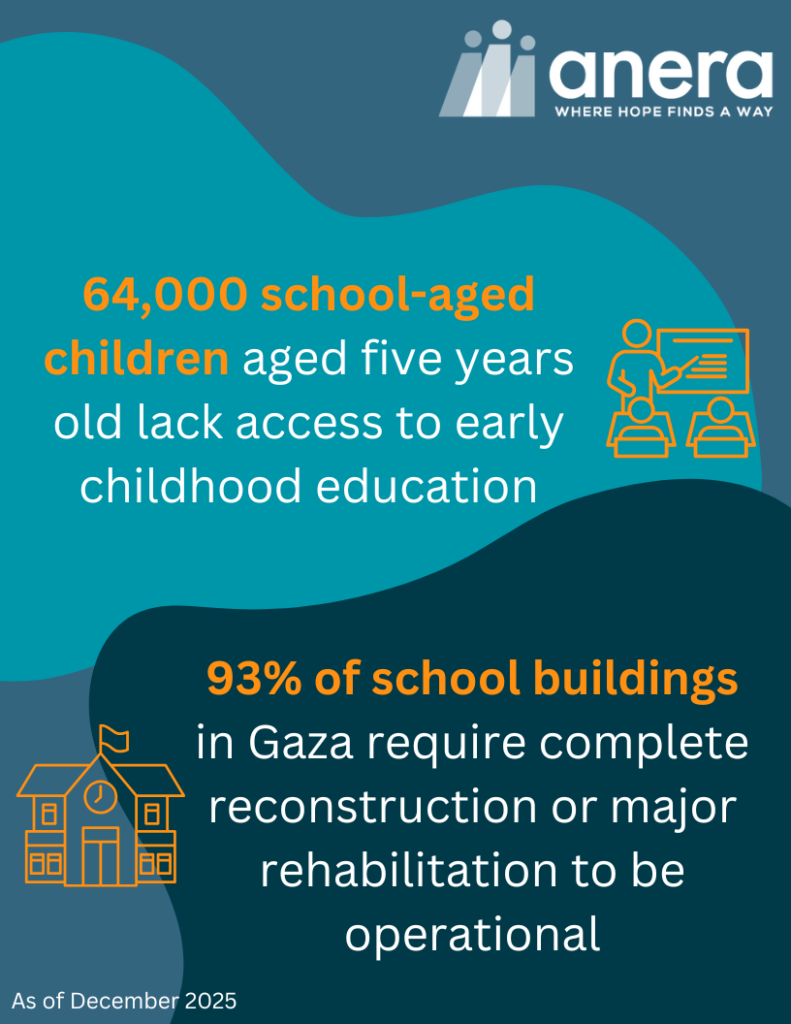
The education system in Gaza has been completely destroyed. Approximately 93% of school buildings will require full reconstruction or major rehabilitation to become functional again, according to OCHA. Nearly all of Gaza’s approximately 660,000 children lack access to formal education. This includes 64,000 school-aged children aged five years old who lack access to early childhood education, posing a risk to proper childhood development.
While marginal improvements have been made since the ceasefire, formal education remains absent. The number of temporary learning spaces increased from 303 in October 2025 to 392 in November 2025, now serving about 220,905 students, or about 34% of school-aged children.
Shelter
More than 288,000 families in Gaza face a shelter crisis. War-damaged buildings and winter conditions combine to make shelter extremely difficult to find. Between December 20 and December 21, 2025, three residential buildings collapsed in the Beach camp and Ash Sheikh Radwan area. Due to the immense lack of shelter, many families have resorted to living in buildings that are partially or mostly damaged simply to protect their families from the winter elements.
Emerging risks of overcrowded shelters and harsh winter conditions include psychological distress, reduced access to safe spaces and heightened vulnerability. Access and mobility constraints continue to disproportionately affect vulnerable populations such as persons with disabilities, women and children. The Gender in Humanitarian Action Working Group reported that 75% of women-headed households urgently need shelter support, and two-thirds of women urgently need clothing.

 by
by