
Seeing Community Beyond Language: Things Will Be Tamam
 by Alicia Phillips Mandaville
Posted in: Programs
I joined Anera’s Ramadan iftar in Ramallah knowing I wouldn’t understand most of the words being spoken. In some ways, it can feel awkward to join a community over a meal when you don’t speak the language. But some things don’t require translation. Some things, you can feel just by being present.
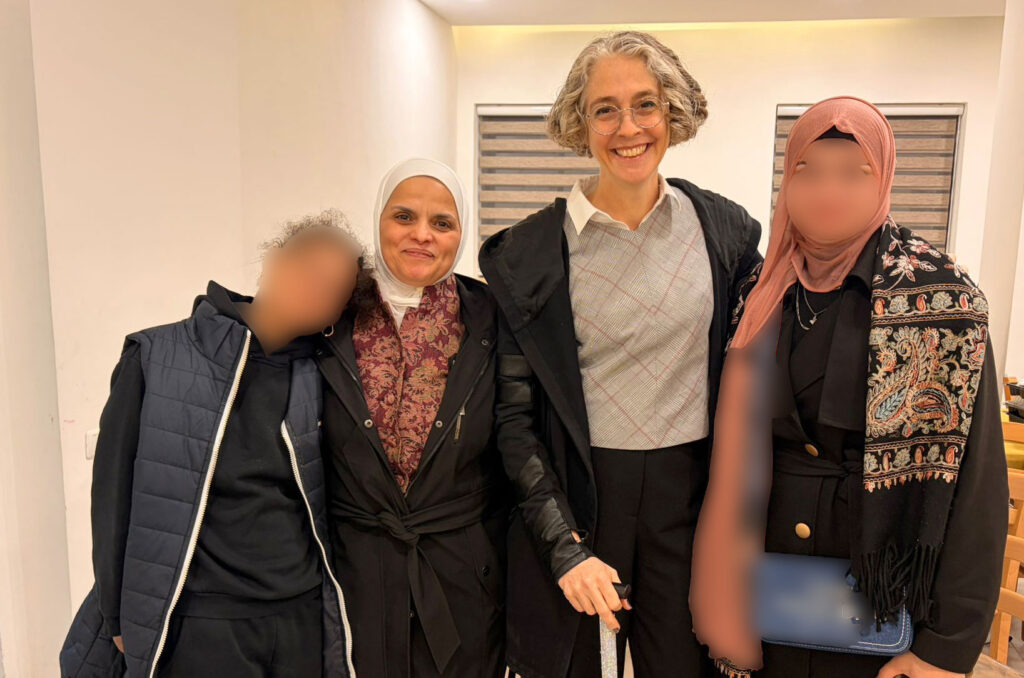
This iftar was for around 60 people, patients who had come from Gaza to the West Bank for medical treatment before the war began in October 2023, and have since been prevented from returning home. The prolonged blockade, imposed since 2007, meant some healthcare treatments were unavailable in Gaza, forcing patients to apply for approval to seek treatment outside the territory. These families had arrived for treatment, only to find themselves stranded by circumstances beyond their control. Today, they live together in a hostel in Ramallah. With no steady source of income, even basic comforts are scarce, yet what began as shared hardship has quietly become shared life.
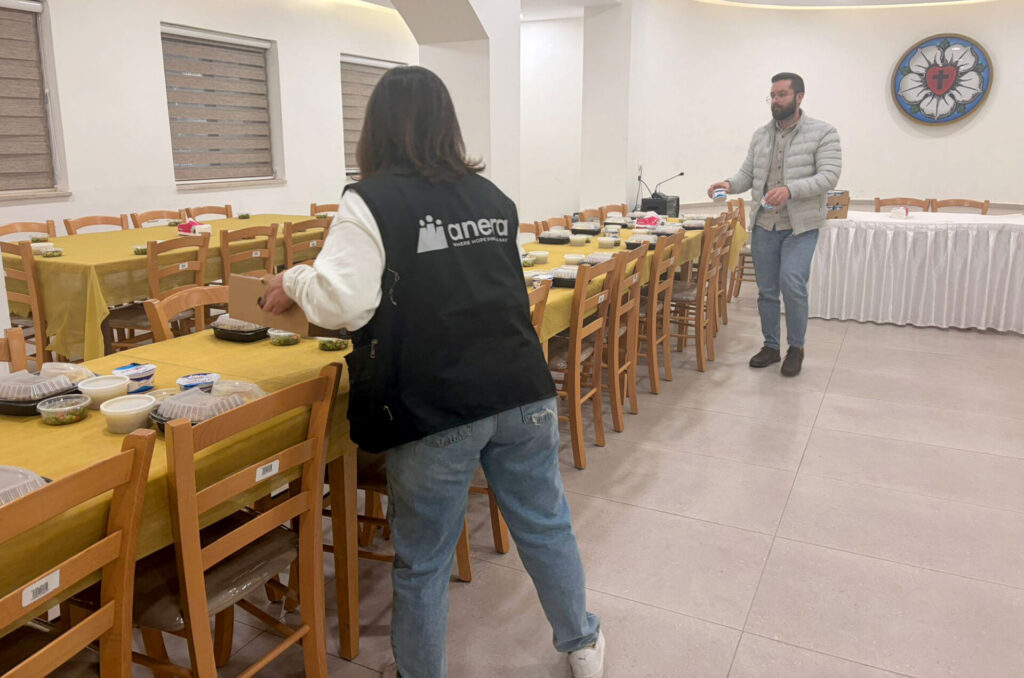
The iftar was held at the Lutheran Church, a space of welcome and hospitality that reflected the deeper spirit of the Palestinian community: interfaith welcome as a lived practice, not a statement. The church became a place for all families to gather, eat, and feel safe, not as guests, but as people among people. It was a small yet powerful reminder that moments like these transcend faith, language, and circumstance.
What I witnessed that evening was not just a meal, it was a community.
Young men stood talking in the corner, sharing words and laughter. Adults sat with relatives they love and depend on, bonds strengthened by time and hardship. And, of course, there were children running in circles. (Truly, I have been all over the world, and somehow, there are always children running in circles. Why circles? Why running? No one knows, but it is absolutely universal, and so here they were too.)
That evening was also made of small moments that stay with you. One woman told me she was happy simply because she had been able to enjoy her first cheese qatayef (a popular dessert traditionally made and served during Ramadan). For families surviving day to day, a dessert like this is a rare indulgence. Not a symbol. Not a metaphor. Just a simple moment of sweetness and normalcy in lives shaped by displacement and endless waiting.
I had the chance to speak with two women whose stories will stay with me.
One was Wala’, just 23 years old. She came to Ramallah in September 2023 so her son could receive treatment for congenital muscular dystrophy. Her three-year-old son passed away in April last year. She faced that loss alone, her husband and family remain in Gaza. Traveling with her son and tending to his medical care left her no time for her studies. Only later, amid grief and isolation, did she find the strength to return to school. Today, she is pursuing a bachelor’s degree in chemistry. Not as an escape from pain, but as a way to keep moving forward, giving structure and meaning to her days, and holding onto a future she can still build.
The second woman was a grandmother in her sixties, caring for her three-year-old grandson, Yamen, who suffers from severe asthma attacks. His parents are in Gaza, and he has grown up almost entirely in her care. He now calls her “mama,” not grandmother, because he left his mother when he was just a few months old and doesn’t remember her. She gently corrects him to say “tata” (grandmother in Arabic — another word I’ve added to my Arabic list), holding onto the hope that he will one day know and be reunited with his mother. She is his home, his constant. Their tenderness was unmistakable: a relationship shaped by separation and illness, yet filled with patience, and quiet strength. She spoke of her hope that, with care and time, his life would be less defined by hospitals and more by childhood.
Each story carried loss. Each carried separation. But what stayed with me most was something else entirely: they were all looking ahead.
They were oriented toward the future, studying, healing, raising children, imagining change, believing in life beyond survival.
For me, it is easy to get lost in the meetings and structures required to keep an organization running. Strategy, operations, planning, all necessary, all important. But being there that evening was a gift and a reminder.
To be part of a meal where language didn’t matter, but presence did. To simply be among people, sharing food, moments, and the courage to imagine a future.
That evening didn’t feel like a program.
It didn’t feel like a required event.
It felt like a community, formed through hardship, sustained by connection, and carried forward by hope.
And as I left, I couldn’t help but think that things will eventually be tamam — a new favorite word I now know to add to my list of Arabic vocabulary, meaning ‘it will be good, and settled well.’
That, more than anything, is what I will carry with me.
 by
by