
April 16 Update on Conditions & Response in Lebanon and Palestine
 by Anera
Posted in: News
Lebanon Update
Lebanon is facing another dangerous chapter in a war that continues to deepen humanitarian needs, damage infrastructure and strain an already fragile country. While diplomatic talks have begun between the governments of Lebanon and Israel, fighting on the ground remains intense, particularly in the south, where airstrikes, displacement and destruction continue.
Since last week, the nature of the war has shifted dramatically. As we reported in our last update, in a single 10-minute period, the Israeli military launched more than 100 air raids across Lebanon, including many hitting the Beirut metro area. Since then, strikes on Beirut and its southern suburbs have temporarily subsided, reportedly under international pressure, but military operations have intensified significantly in southern Lebanon.
To date, since the beginning of the war, approximately 2,000 people in Lebanon have been killed and more than 6,500 injured. These numbers reflect not only the scale of violence, but also the severe pressure placed on Lebanon’s health system, which was already weakened by years of economic crisis. Hospitals in the south are struggling under the volume of casualties, while health workers and medical facilities are themselves being targeted or caught in active fighting zones.
The destruction is immense. According to Lebanese government estimates, some 40,000 housing units have been completely or partially destroyed, with 70% of that damage concentrated in southern Lebanon.
Ground operations in southern Lebanon seem to be expanding. Reports indicate that entire communities in the south, like Bint Jbeil, are now surrounded, inaccessible or emptied. In many areas, homes, roads, water systems and agricultural lands have all been devastated.
Cities further north are now being hit more heavily as well. Nabatieh, long a critical hub in the south, has seen intensified bombardment in recent days. Humanitarian access remains highly unpredictable. An Anera relief convoy prepared to reach a frontline community was initially cleared by the United Nations, only to be halted at the last minute because conditions became too dangerous. The convoy had to be redirected elsewhere, illustrating how rapidly access conditions can change.
At the same time, displacement is reshaping daily life across the country. Lebanon now has an estimated 1.2 million displaced people, with a small percentage staying in shelters. Many families are instead living on the streets, in unfinished buildings, in overcrowded homes with relatives, or near damaged neighborhoods they fled.
For many, staying close to home is a matter of survival. Remaining near their communities may offer access to belongings, neighbors, informal work, schools or scarce local resources that would be lost if they moved far north into formal shelters. Others simply do not want to enter crowded shelters where privacy, dignity and stability are limited.
The private rental market has become inaccessible for most displaced families. Apartments that previously rented for $300 to $400 per month are now reportedly being offered for $1,800 to $2,500 in some areas. Landlords are also frequently demanding six months to a full year of rent upfront, making even temporary housing impossible for households that have lost income or exhausted savings.
At the same time, a diplomatic opening has emerged. For the first time in a very long period, the Lebanese government has formally requested negotiations with Israel aimed at reaching a ceasefire or broader de-escalation. The first round of talks took place two days ago under U.S. mediation, with a second meeting scheduled for next week.
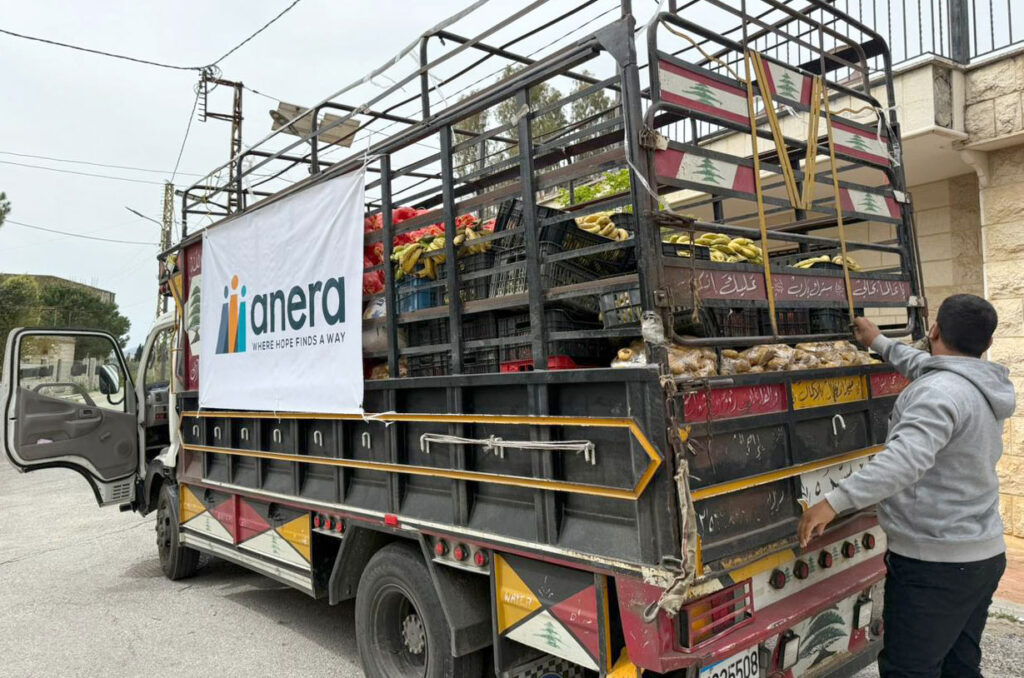
Meanwhile, humanitarian response efforts continue across the country. Health remains one of Anera’s highest priorities, with emergency shipments of medicines and medical supplies going out to hospitals nationwide. We have delivered three ventilators to hospitals in southern Lebanon, while our teams are procuring additional medicines and lifesaving supplies in anticipation of further escalation.
Anera’s bread distributions, hot meals and ready-to-eat food packages continue across Lebanon, particularly in displacement shelters. Assistance is now expanding beyond shelters because so many displaced families are living elsewhere – in informal camps, rented apartments, unfinished buildings or with host families. Anera is coordinating convoys with humanitarian partners to reach these hard-to-access communities where people urgently need food, fuel and clean water.
To date, Anera’s relief efforts have reached more than 300,000 people, representing roughly 30% of those estimated to be in need. Humanitarian teams are also working in 206 of Lebanon’s 678 shelters, almost 30% of all official shelter sites, while increasingly expanding support outside those formal locations. The total value of the aid Anera has delivered since the start of the escalation is approaching $1 million, reflecting the scale of growing humanitarian demand.
Yet the crisis in Lebanon is not only military or humanitarian. It is also social and political. Lebanon today is confronting multiple crises at once: war, displacement, political division, economic collapse and humanitarian need. While diplomacy offers a possible path forward, families across the country continue to live with uncertainty, fear and loss.
The immediate need remains clear: protection for civilians, safe humanitarian access, support for hospitals and displaced families, affordable shelter solutions and sustained efforts to preserve social stability in a country carrying an ever-heavier burden.
Palestine Update
Please check out our response log to learn about what Anera is doing in Palestine.
Daily life in Gaza and the West Bank is marked by violence, displacement, shortages and the steady erosion of normal life.
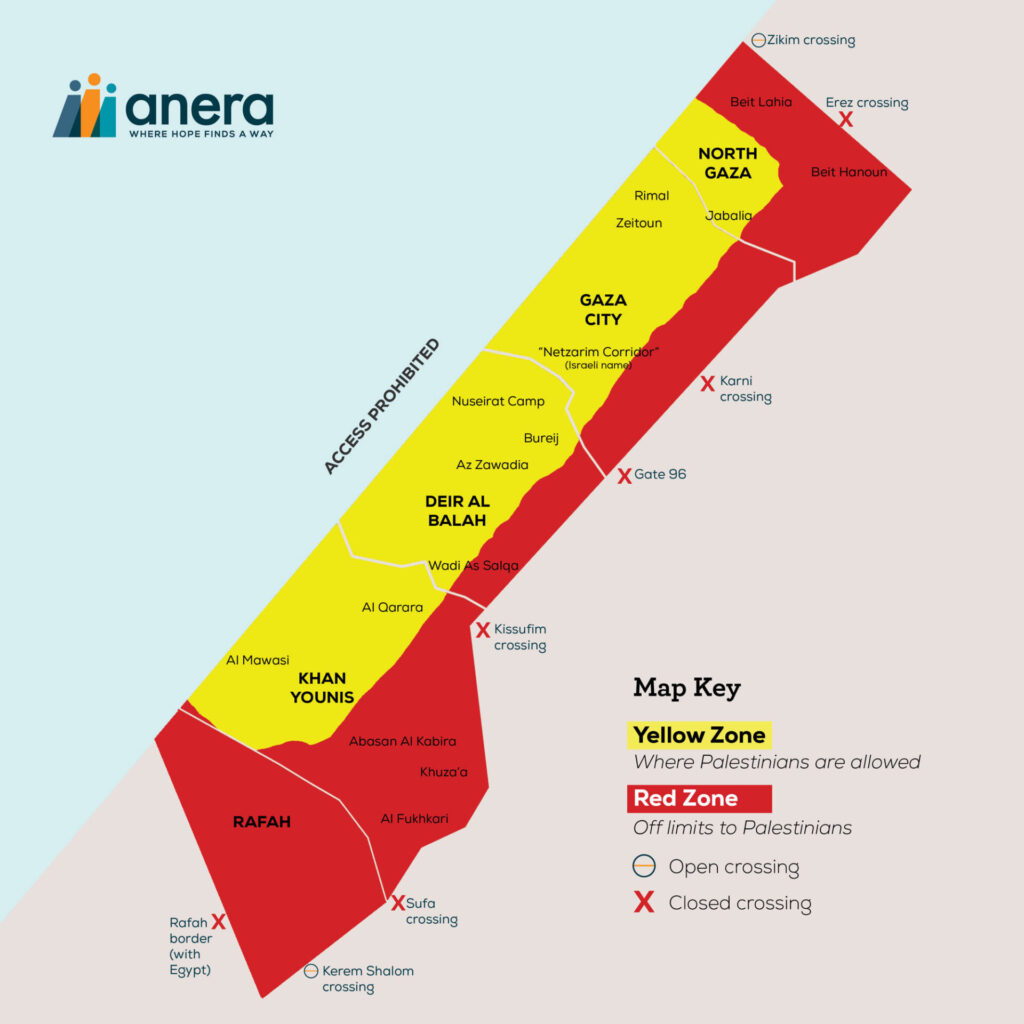
In Gaza, the ceasefire declared last October has not brought true safety. Since that time, 736 Palestinians have been killed and more than 2,000 injured. In just the first weeks of April, more than 20 people were killed.
Humanitarian access continues to be one of the most urgent challenges. Between April 1 and April 14, approximately 800 aid trucks were scheduled to enter Gaza. Of those, only 720 trucks were offloaded, while close to 10% of shipments were rejected or turned back. Most of the aid entering remains food assistance, accounting for roughly 74% of deliveries, while fuel made up only 3-4%, which is far below what hospitals, water systems, bakeries and humanitarian agencies require.
These restrictions mean that everyday survival is an exhausting struggle. Diesel prices inside Gaza have climbed to $12–13 per liter, hundreds of times higher than before the war. Cooking gas remains scarce and can cost $25-30/kilogram, compared with around $1–2 before the war. As a result, more than half of Gaza’s families now rely on burning waste to cook meals, exposing households to serious health and environmental risks.
Store shelves are mostly bare. Around 71% of retailers in Gaza report critically low stock levels, making even basic household items difficult to find. Food quality has also deteriorated sharply. According to humanitarian sources, protein consumption has dropped from around three days per week before the war to just 1.3 days per week now. For many families, this means children and adults are eating protein only once a week, if that.
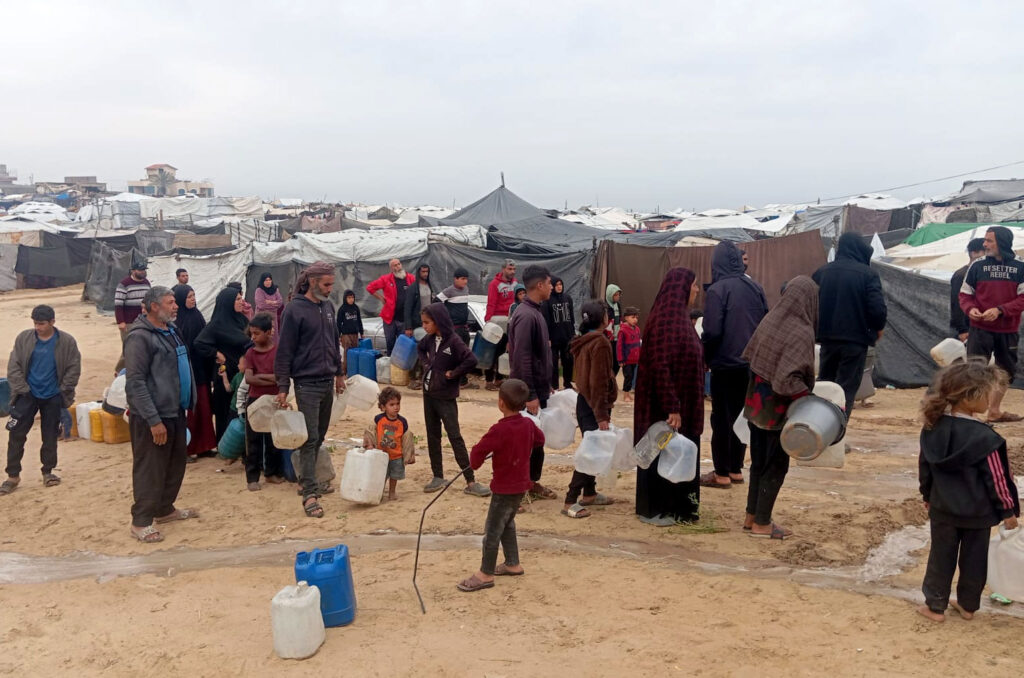
Living conditions are worsening at a dangerous pace. Assessments from some 1,600 displacement sites indicate that 80% of the sites report pest infestations, while 50% report widespread skin disease. There are reportedly 320,000 housing units across Gaza that have been damaged or destroyed, yet rebuilding remains nearly impossible because construction materials and fuel are still heavily restricted. Families remain crowded into tents, damaged homes or makeshift shelters with little privacy or protection.
In the West Bank, the crisis is unfolding differently but with equal urgency. Since 2025, more than 33,000 Palestinians have been displaced from (long-established)refugee camps, villages and towns. The situation is described by some observers as the largest displacement there since 1967.
Violence has intensified as well. In 2026 alone, more than 580 settler attacks have been recorded. In March, some 170 Palestinians were injured, the highest monthly toll so far this year. In just one week – from April 1 to April 6 – another 47 settler attacks were documented with 50 Palestinians injured. That amounts to several attacks and injuries every single day.
Military operations have also increased, particularly in northern West Bank areas such as Jenin and Tulkarem. Closures, checkpoints and roadblocks continue to restrict movement between cities and villages, making it harder for families to reach jobs, schools, farmland and healthcare.
The economic damage is profound. Poverty across Palestine has reached roughly 42%, while unemployment in the West Bank is estimated at around 30%. Since 2022, the broader Palestinian economy has reportedly shrunk by nearly 70%, stripping households of savings, income, and stability.
At the same time, civil society institutions that often fill gaps left by the crisis are themselves under pressure. This week, Israeli authorities ordered the closure of a major charitable organization in Hebron that has operated since 1962. The organization provided orphan care, schools, food assistance, bakeries and support for vulnerable families. During the closure, authorities reportedly confiscated around $160,000 in humanitarian goods, along with bakery and kitchen equipment worth another $50,000. Among those affected are approximately 240 children living in the organization’s orphan care facilities.
What is happening across Palestine today cannot be measured only in military terms. It is also a crisis of blocked aid, collapsing livelihoods, displacement, hunger and the dismantling of the institutions families depend on to survive. These realities often receive less attention than ceasefire talks or battlefield updates. But for millions of Palestinians, they are the defining facts of daily life.
The need now is not only for political agreements, but for meaningful protection of civilians, reliable humanitarian access, economic recovery and the chance for communities to live with dignity and security again.
 by
by