
What It Means to Keep Going in Gaza
 by Yazdan El Amawi
Posted in: Report
Yazdan is Anera’s branch director in Gaza
In Gaza, we have learned not to believe anything until we see it. Announcements are made. Timelines are promised. Crossings are said to be opening. Conditions are said to be improving. And yet, for the past two and a half years, reality has taught us caution. We measure progress not in words, but in what actually reaches people’s hands.
Over the past month, daily life in Gaza has remained brutally hard. Prices fluctuate and access shifts from one day to the next. There are small moments of easing, followed by renewed obstacles. Families constantly search for the most basic things – food, water, shelter, medicine – while waiting for the ceasefire’s promised next phase to bring real relief.

Despite this uncertainty, our teams have kept moving.
Over the last five weeks, Anera has continued to respond at scale across Gaza, delivering aid day after day, often under conditions that change by the hour. Every delivery requires coordination, negotiation and persistence. None of it is simple, but all of it is necessary.
Food has remained one of the most urgent needs. During this period, our team here distributed 16,000 hot meals every single day. We also delivered thousands of food and vegetable parcels, carefully adjusted week by week as we assessed market availability and family needs. Each parcel contained around 20 kilograms (44 pounds) of fresh produce, enough to support a family’s food needs for nearly two weeks..
Clean water has been just as critical. Through ongoing water trucking, we distributed roughly half a million gallons of potable water over the past month, primarily in Gaza City and the central areas. To reduce risk and congestion, we also began installing large steel water tanks inside displacement camps, which is an investment not just in access, but in safety, especially for children.
Shelter remains a daily concern for families living in makeshift conditions. Over the past month, we distributed hundreds of tents, winter clothing items and essential supplies like diapers. In our integrated community camps alone, about 1,500 families now have more stable shelter than they did just weeks ago, representing a small but meaningful step forward.
Health services have continued without pause. Anera is currently operating six clinics across Gaza: three primary health clinics and three maternity clinics. In just over a month, our clinics served approximately 27,000 patients. Every consultation represents someone who was able to see a doctor, receive medicine or safely give birth despite the surrounding devastation.
At the same time, we are trying, wherever possible, to look beyond survival alone and begin restoring livelihoods. Through small greenhouse rehabilitation projects, we are providing training and materials to Gaza farmers to help them get on their feet and grow fresh, healthy food again. Through women-led pastry and food production initiatives, families are generating income while providing food to others. Through small business grants, we are preparing dozens of entrepreneurs to reopen shops and services that once anchored their communities.
Children, too, remain at the center of our work. Education in Gaza today looks very different than it once did, but it has not stopped. Over the past five weeks, Anera-supported programs reached thousands of children through temporary learning spaces, early childhood education centers, psychosocial support sessions and hot meal programs linked to schooling. These spaces offer more than lessons. They offer routine, safety, and a sense that childhood still matters.
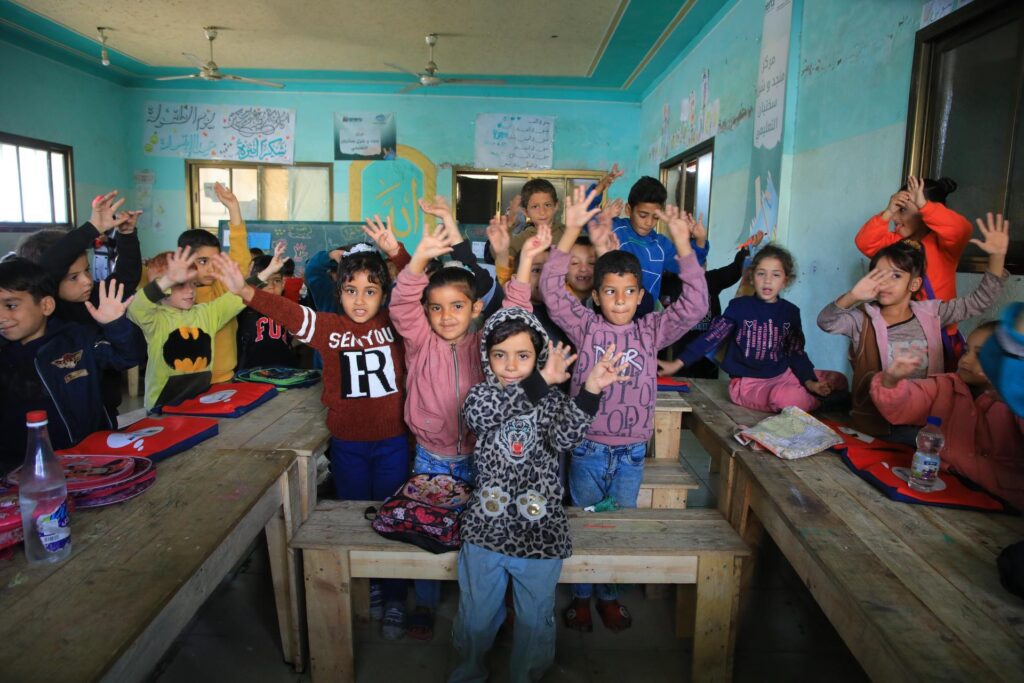
One of the most complex efforts underway is our integrated community model, serving nearly 1,800 families (more than 9,000 people) across multiple displacement camps. Here, aid is not delivered in isolation. Families receive shelter, food, water, sanitation, healthcare, psychosocial support and education together, as a system. It is slow work. Supplies are hard to source and materials are limited. But this model reflects how people actually live and what they actually need to recover.
The people of Gaza continue to endure extraordinary hardship with patience and strength that humbles us daily. Our responsibility is to match them – to show up, again and again, with whatever is possible, while pushing for what must still change.
We will keep working, adapting and believing, not in promises, but in what we can build, one delivery at a time.
 by
by  by
by